
Microbiotes
Can Your Gut Decide the Fate of Your Medicine?
Why do some patients respond well to a drug while others experience limited efficacy or severe side effects, even when receiving the same treatment and dose?
In addition to host genetics and environmental factors, increasing evidence identifies the gut microbiota as a decisive modulator of drug response. This growing field, known as pharmacomicrobiomics, focuses on understanding how gut microorganisms influence drug metabolism, therapeutic efficacy, toxicity, and immune-related outcomes.
What Pharmacomicrobiomics are about ?
Pharmacomicrobiomics builds on classical pharmacology and pharmacogenomics by recognizing the gut microbiota as a metabolically active “hidden organ.” The human gut microbiome encodes a vast array of enzymes capable of transforming drugs through reduction, hydrolysis, deconjugation, and other biochemical reactions. These microbial transformations can occur before drug absorption in the intestine or after hepatic metabolism, thereby altering drug bioavailability and pharmacological activity (1,2).
Are there any concrete pharmacobiotic studies that highlighted the intricate relationship between microbiota and drug pharmacokinetics ?
Several representative examples highlight the importance of these interactions. The cardiac drug digoxin can be reduced and inactivated by the gut bacterium Eggerthella lenta, leading to decreased therapeutic efficacy in individuals harboring high levels of this microorganism (3). In oncology, irinotecan, a widely used chemotherapeutic agent, is converted in the liver into an inactive glucuronide conjugate; however, bacterial β-glucuronidases in the gut can reactivate this compound, resulting in intestinal toxicity and severe diarrhea (4). Similarly, the antidiabetic drug metformin has been shown to exert part of its glucose-lowering effect by reshaping gut microbiota composition and enhancing short-chain fatty acid production, rather than acting solely through host pathways (5).
Microbiota and the immune system: a bidirectional dynamic
Beyond drug metabolism, the microbiota also modulates the immune system, thereby indirectly influencing drug response. Gut microbes regulate immune cell differentiation, cytokine production, and inflammatory tone, which are critical determinants of therapeutic outcomes, particularly for immunomodulatory drugs. In cancer immunotherapy, for example, specific microbial taxa have been associated with improved responses to immune checkpoint inhibitors by enhancing antigen presentation, T-cell activation, and antitumor immunity (6). Conversely, dysbiosis may promote chronic inflammation or immunosuppression, reducing drug efficacy and increasing adverse effects.
Pharmacomicrobiomics therefore describes a bidirectional and dynamic interaction: drugs can alter microbiota composition, while the microbiota influences drug destiny and immune signaling. Antibiotics, proton pump inhibitors, and non-steroidal anti-inflammatory drugs are well-known examples of medications that profoundly reshape microbial communities, sometimes leading to long-term consequences for host immunity and metabolism (2,7). These changes may affect not only the treated disease but also the patient’s response to subsequent therapies.
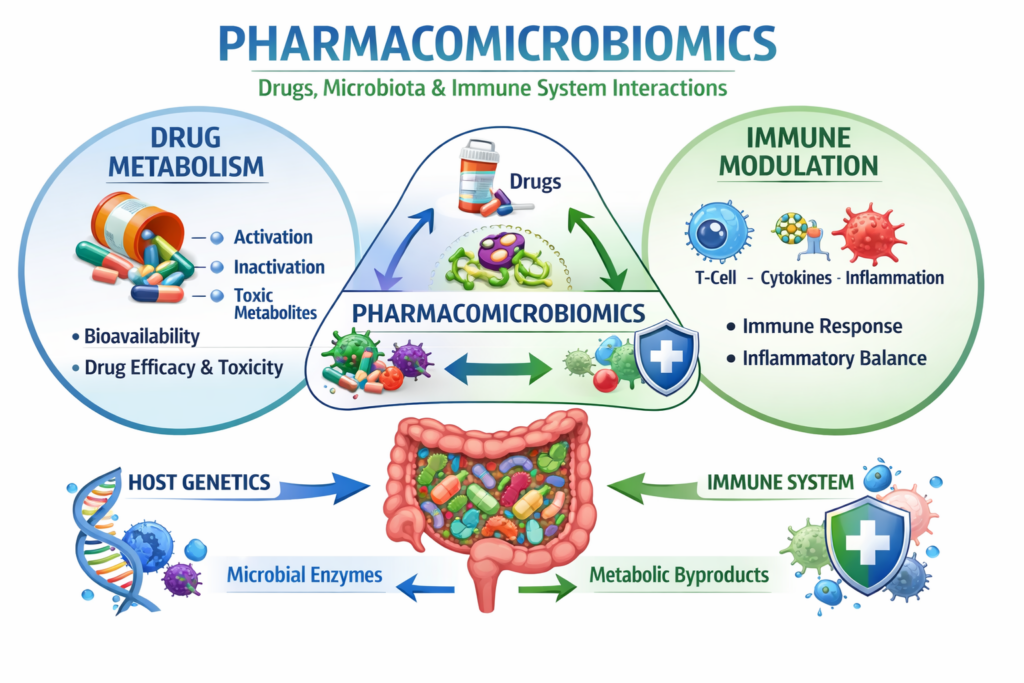
Drugs, Microbiota and immune system Interactions
From a clinical perspective, integrating pharmacomicrobiomics into precision medicine holds major promise. Microbiota profiling could help predict responders and non-responders, identify patients at risk of toxicity, and guide personalized dosing or adjunct probiotic and dietary interventions. For students and researchers, pharmacomicrobiomics provides a systems-level framework that connects pharmacology, microbiology, metabolism, and immunology into a unified model of drug action.
Last but not least …
At the end of the tunnel, it is pretty obvious that pharmacomicrobiomics reveals that drug response is not solely dictated by the drug and the host genome but emerges from a complex interaction involving the microbiota and the immune system. Understanding these interactions opens new avenues for safer, more effective, and personalized therapeutic strategies, particularly in diseases with complex therapeutic schemes such as Cancer and metabolic disease.
References
- Clayton TA, Baker D, Lindon JC, Everett JR, Nicholson JK. 2009. Pharmacometabonomic identification of a significant host–microbiome metabolic interaction affecting human drug metabolism. Proc Natl Acad Sci USA 106(34): 14728–14733.
- Haiser HJ, Turnbaugh PJ. 2013. Developing a metagenomic view of xenobiotic metabolism. Pharmacol Res 69(1): 21–31.
- Haiser HJ, Gootenberg DB, Chatman K, et al. 2013. Predicting and manipulating cardiac drug inactivation by the human gut bacterium Eggerthella lenta. Science 341(6143): 295–298.
- Wallace BD, Wang H, Lane KT, et al. 2010. Alleviating cancer drug toxicity by inhibiting a bacterial enzyme. Science 330(6005): 831–835.
- Forslund K, Hildebrand F, Nielsen T, et al. 2015. Disentangling type 2 diabetes and metformin treatment signatures in the human gut microbiota. Nature 528: 262–266.
- Routy B, Le Chatelier E, Derosa L, et al. 2018. Gut microbiome influences efficacy of PD-1–based immunotherapy against epithelial tumors. Science 359(6371): 91–97.
- Spanogiannopoulos P, Bess EN, Carmody RN, Turnbaugh PJ. 2016. The microbial pharmacists within us: a metagenomic view of xenobiotic metabolism. Nat Rev Microbiol 14: 273–287.